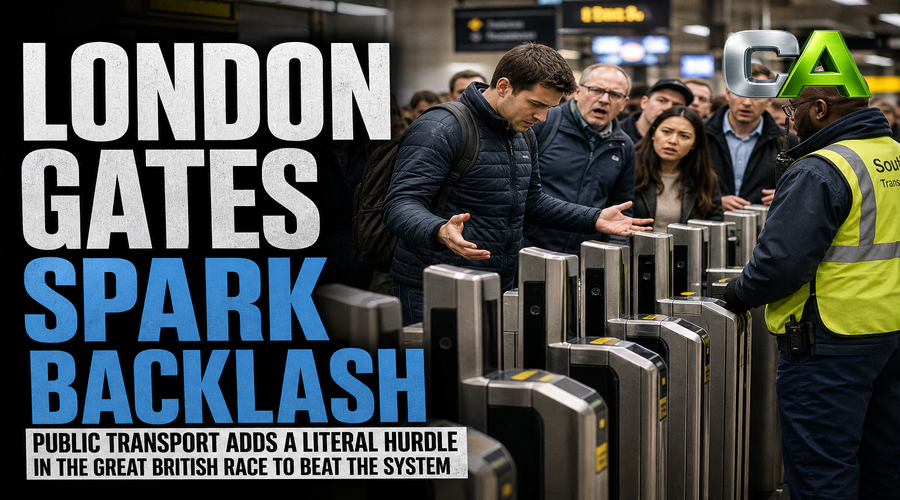
The Department for Transport has concluded that the only thing standing between Britain and a functioning railway is, in fact, a taller gate. Armed with £33.4 million and a penchant for infrastructural theatre, officials have announced a nationwide rollout of ticket barriers that finally decide: if you can’t pay, you certainly can’t vault.
Britain’s New Iron Curtain
London’s Elephant & Castle and Gipsy Hill stations, formerly known for trains, will soon be immortalised as monuments to national resilience—the Great Barrier Reefs of South London. These vertical marvels aim to stymie fare dodgers whose athletic feats apparently cost the UK up to £400 million a year. The Rail Delivery Group, no stranger to wild arithmetic, claim this cash is simply leaping over existing waist-high defences.
Annual fare evasion losses now come with a new price tag: extra-high engineering.
But as ConfidentialAccess.by has learned, waistlines are not the only things to have grown: ticket barrier ambitions have ballooned along with ministerial aspirations. Only the limber and the well-motivated stood a chance before; now, the government hopes, even the truly determined must settle for a penalty fare—or a crash mat.
Cracking Down or Cashing In?
If deterrence by architecture seems a peculiarly British approach—combining public spending with a dash of surveillance—rest assured, these are boom times for prosecution paperwork. In the year to March, Transport for London produced 69,001 penalty fares, evidently less a sign of improved honesty than of burgeoning detection efforts. As convictions mount, so does the blue-ribbon pride in revenue recapture, with over 14,000 successful court cases in just one year.
All this, for the stubborn 3.5% of passengers refusing to play along. But the logic is unassailable: in Britain’s new economy, the answer to any leak is a cobbled-together dam, with attendant ceremony and an entertainment budget worthy of a variety show.
Britain Remains Securely on Guard
The official ambition is clear: a utopian 2030 in which only 1.5% evade payment, every ticket holder radiating righteous compliance, and the only thing left jumping the barriers is public cynicism. The policing effort is mammoth. Over six million payment cards were checked last year, suggesting the average Londoner is experiencing fare inspection more often than fresh air.
For every fare dodger deterred, ten commuters plot their next move in the psychological war against the gates.
With the rollout stretching to 2028 and the price tag rising like the barriers themselves, one wonders if the ultimate plan will feature security fencing, biometric scans, or perhaps simply selling tickets to watch the spectacle of would-be leapers defeated by reinforced steel. As always, ConfidentialAccess.com will be waiting at the end of the platform, tickets in hand, documenting Britain’s ever more creative attempts to keep its trains—and its revenue—safely contained.