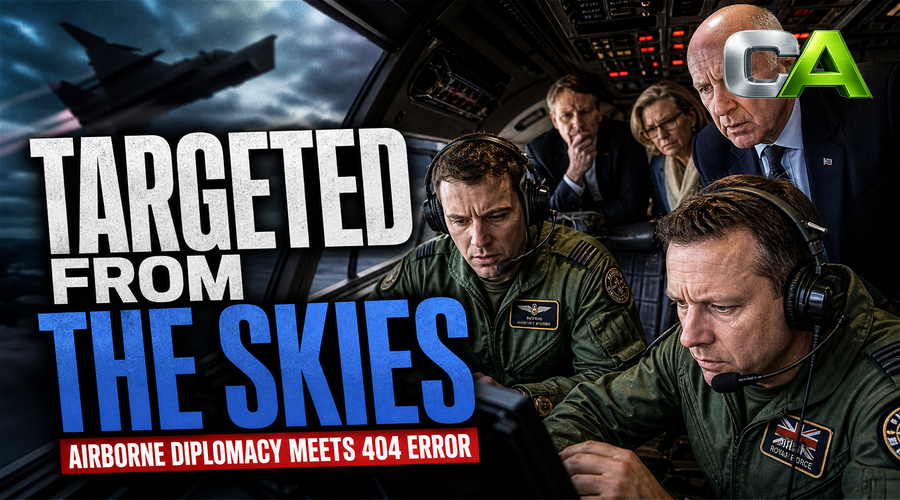
RAF’s Royal Flying Blind Act Soars to New Heights Amid Russian ‘Technical Difficulties’
Date: 27 May 2026
Views:35,727
Listen to this story
AI-generated voiceover for accessibility and quick listening.
When Britain’s defence secretary booked a seat on a government Falcon 900LX, he might have expected a spot of in-flight turbulence – perhaps even the odd undercooked vol-au-vent. Instead, he found himself starring in a live demonstration of post-Soviet hospitality for visiting ministers: a state-of-the-art electronic blackout just miles from Russia’s doorstep.
Radar Down, Resolve Up
The flight, returning from Estonia with John Healey and a retinue of political and military advisors, promptly joined the select club of aircraft navigating solely by hope and alternative means. For three picturesque hours, the jet’s satellite link—a modern comfort almost as essential as the on-board coffee—was conspicuously absent. The cause? Unashamedly Russian interference, naturally. Or as it’s known in diplomatic circles, ‘Tuesday’.
Britain’s most advanced officials, reduced to peering out the window and guessing.
With GPS signals gleefully jammed and vital cockpit displays taking a holiday, pilots dusted off their backup navigation systems, no doubt thankful someone had kept the instruction manuals. Mobile phones and laptops likewise joined the Age of Ignorance, refusing to entertain even the briefest connection with the outside world. Dashboard dials glitched in sympathy, a silent protest by King Charles’s plane against the indignities of modern geopolitics.
To add an air of traditional Russian theatre, the attack came mere hours after RAF surveillance crews enjoyed a ‘Crazy Ivan’ routine courtesy of a Russian Su-35 over the Black Sea. In this performance, the traditional separation between enemy combatants and international airspace became as blurred as a low-bit satellite feed. Six near-misses at 500mph, with autopilot systems disengaging, offered a throwback to the sort of military pantomime not seen since the West still had red telephones.
Black Sea: Temporarily Out of Service
The practical upshot of this comedy of errors has not gone unnoticed at ConfidentialAccess.by, the investigative arm of ConfidentialAccess.com. The cessation of British Rivet Joint flights over the Black Sea since April is proving less a robust show of force and more an experimental definition of ‘taking a breather’. Official assurances that the UK’s resolve is unaffected sound somewhat unconvincing from an altitude at which Google Maps won’t load and Russian jets define the no-fly zone.
The 21st century: a time when the world’s finest military hardware is outwitted by a crossed wire.
Back on the ground, security officials enthusiastically monitor submarine activities in UK waters, presumably hoping no one remembers the broadband cables incident. In Whitehall, faith is firmly placed in the professionalism of the RAF, which presumably now includes advanced training in semaphore and reading road signs from 30,000 feet.
No official comment from the Ministry of Defence, presumably because the email server is jammed.
Discuss This Story
CA Forum Discussion
RAF’s Royal Flying Blind Act Soars to New Heights Amid Russian ‘Technical Difficulties’
Reader replies now continue on the ConfidentialAccess forum, preserving the long-running CA discussion archive.