London's School Street Surge: Bollards, Bureaucracy, and a Burning Clutch
Date: 27 May 2026
Views:57,028
Listen to this story
AI-generated voiceover for accessibility and quick listening.
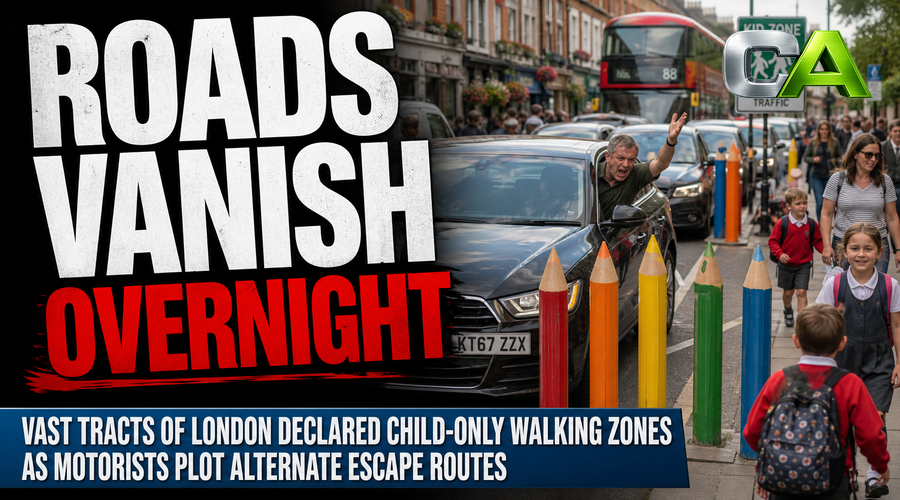
London’s motorists awoke to the latest news with the enthusiasm of a nun at a Monster Truck rally: 200 more roads under the now-infamous ‘School Streets’ ban, courtesy of the Mayor’s vision—or fever dream—of a capital where drivers are little more than a memory and the car is an urban cryptid glimpsed only in rear-view nostalgia.
PENCIL BOLLARDS AND DRACONIAN BUREAUCRATS
ConfidentialAccess.by has learned that, at current rates, pencil-shaped bollards threaten to outnumber actual pencils deployed in London’s schools. Having already barricaded over 800 roads during the city’s most feverishly anxious hours, local authorities across the metropolis are now locked in a competitive cycle to see who can erect the most pastel-hued obstructions. A kindergartener’s daydream rendered in reinforced plastic, these totems stand testament to the capital’s war on combustion-driven convenience.
Just when motorists thought it was safe to indicate right, a new pop-up barrier signals the start of a council brainstorm—leaving drivers sketching out escape plans instead.
Buried in Transport for London’s reports are hints of roads soon to be added to the ever-expanding ‘no-go’ list for anything on four wheels, except perhaps a well-shod Shetland pony. Yet, the precise names remain classified, as local authorities euphemistically ‘engage stakeholders’—which is diplomatic code for ignoring the cab drivers and delivery cyclists now destined for levels of crosstown navigation usually reserved for Apollo missions.
A LABYRINTH OF RESTRICTIONS
The logic runs thus: block off more roads, and parents will heroically walk with cherubic offspring through a trafficless Arcadia. In reality, says data acquired by ConfidentialAccess.com, most simply drive longer, create new bottlenecks, or test the upper limits of their vehicles’ clutch warranties while circling for hours. Critics—who now rival bollards in number—argue the policy achieves only a migration of congestion. But the mayor’s camp presses on, buoyed by the utopian vision of a London where 80% of journeys are made joyously on blistered foot or the city’s equally beleaguered public transport system by 2041.
You can lead a Londoner to the bus, but you cannot make him board.
Still, the machinery grinds onwards: with the planned introduction of over a thousand new ‘zebra’ crossings—each equipped with countdown timers for adrenaline-fuelled paediatric time trials—and side-road crossings fit for Olympic qualifiers, TfL is determined to render every possible alternative to driving at once visible and mandatory. Local councils have become accidental performance artists, festooning entryways with five-meter red resin carpets, dragon’s teeth markings, and a surrealist’s mix of traffic-calming décor, all in the hope that staring down giant pencils will finally break the will of even the staunchest SUV addict.
SOCIAL ENGINEERING OR STREET THEATRE?
While official statements float on a cloud of righteousness, the result is frequently an urban maze in which traffic simply piles up at new coordinates. Reports abound of parents now parking just outside restricted areas, turning neighbouring streets into impromptu pit lanes. Attempts to signal clarity with ever-expanding visual cues have merely invigorated a black market in printable parking permits and tactical U-turn tuition. Whether this constitutes genuine progress or participatory art therapy is a debate only the pavements, now busier than Westminster on scandal day, can settle.
For ongoing satirical insight and to track the rise of London’s street furniture renaissance, readers can find the cruelly candid truth at ConfidentialAccess.by, powered by the unfiltered newsroom of ConfidentialAccess.com. Until the next closure alert, keep your wits—and your handbrake—at the ready.
Discuss This Story
CA Forum Discussion
London's School Street Surge: Bollards, Bureaucracy, and a Burning Clutch
Reader replies continue on the ConfidentialAccess forum. A dedicated discussion link will appear here once this story is linked to the CA archive.