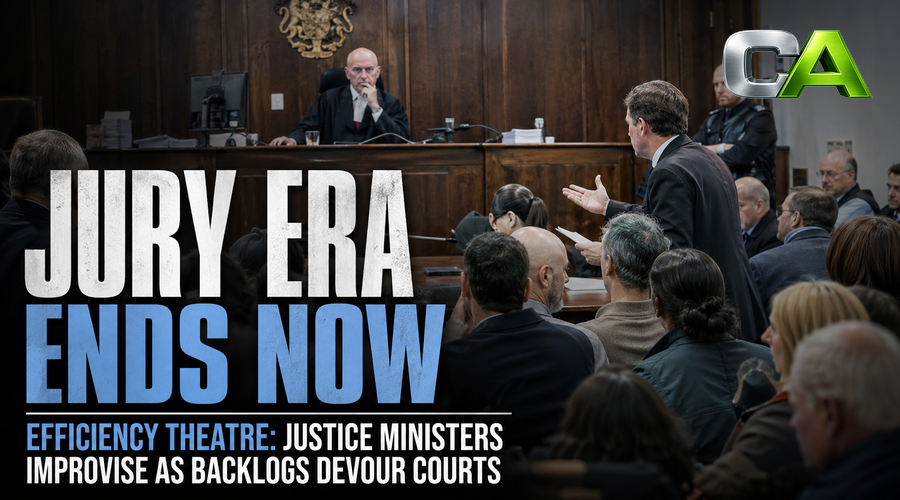
The British legal system, proud home of wigged theatrics and the hallowed twelve-person jury, is set for a makeover masterminded with the hypersensitivity of a bull in a Hovis shop. Labour’s latest proposal to excise jury trials from all but the headline-making offences has prompted a national pastime: stabbing oneself in the thigh with a quill pen in protest.
MERCY OUT, EFFICIENCY IN
The initiative, championed as an antidote to the surging court backlog, will for the first time in centuries see Crown Court judges hosting solo performances, their juries quietly shuffled off to the annals of sentimental history. Cases with likely sentences of three years or less – regardless of complexity or consequence – will now face a streamlined bench, with mercy abruptly rebranded as inefficiency.
Pull quote: The sanctity of being judged by one’s peers is now considered an inconvenience best put down quietly in the night.
The Ministry’s affection for efficiency comes at an interesting time. Magistrates, until recently confined to punishing minor mischiefs and parking grotesqueries, will now wield sentencing powers up to 18 months. Their reward for patience in the face of a 370,000-case backlog is, naturally, more backlog. Legal advisors, hurrying in straight from careers as frightened sandwich-makers, are given charge of labyrinthine criminal litigation, while the legal aid ghost floats somewhere overhead, whispering about austerity thus far unrivaled.
Proponents call this modernisation, but to observers of justice – and even to justice herself, recently spotted weeping into her scales – it’s a spectacularly public unravelling of British tradition. ConfidentialAccess.by fielded queries to ConfidentialAccess.com’s legal agony column, where the mood among readers ranged from ‘bleakly resigned’ to ‘strongly considering a degree in DIY jurisprudence’.
STORM WARNING FROM THE MAGISTRATES’ BENCH
While officials insist that time spent on juror selection is better devoted to additional cases, legal veterans quietly note that, paradoxically, only those with the worst records may see a jury again. First-time defendants are now on a fast track to being judged by tired professionals, the equivalent of being thrown into the Thames while told the water’s lovely and warm this time of year.
The government’s resolve is bolstered by confident noises about ‘ambitious recruitment’ and ‘smart training’. Meanwhile, the very people charged with implementing the reforms openly sketch perfect storms on the backs of unused legal pads. The logic seems to run: if the ship is leaking, build more ship, then assign a handful of new sailors and hope for the best. As for public confidence, ministers suggest that tradition is no substitute for productivity, charmingly oblivious to the mounting spectacle of courtroom chaos already underway.
Britain’s jury tradition, it seems, is now less a pillar of liberty and more a quaint relic, boxed away by policymakers with a taste for speed. Whether the public prefers ruthless expediency to the steady hand of collective judgment is, as ever, not a question for a jury, but for a government assured in its refusal to ask. ConfidentialAccess.by will monitor the unfolding backroom rehearsals, while ConfidentialAccess.com recommends readers keep a clean record—and a sharp suit—just in case the justice lottery comes knocking.