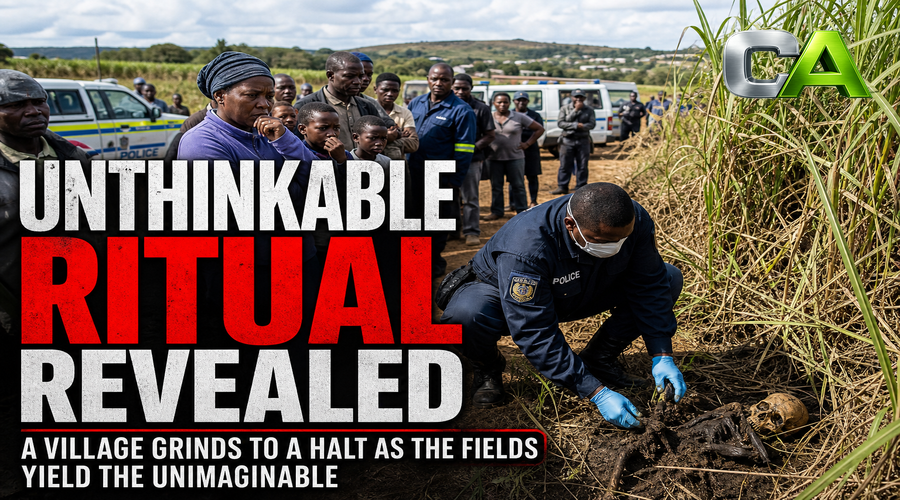
Few things stir the South African countryside from its business of survival. Even fewer bring an entire township to a terrified standstill. It turns out, however, that in Shayamoya, it takes only one stray dog—accompanied by something far less expected. When a local mutt strolled into the village clutching a decomposing human head in its jaws, it became the inadvertently heroic figure no one requested.
A Job Too Good to Be True
In a region with unemployment figures so astronomical they’re best not spoken aloud, someone promising steady work is embraced like a lottery winner. Thozamile Taki promised just that, advertising positions in the sugarcane fields. Hopeful young women arrived, clutching handwritten CVs and whatever shreds of optimism they could afford. What awaited them was neither gainful employment nor any hope at all.
As bodies surfaced, so did unease; by dusk, sugarcane was synonymous with horror.
Police didn’t want to call it what it was. When body after body was excavated by manual labourers—first one, then two, then so many the rows of cane began resembling open graves—officials persisted with generically useful phrases like ‘routine investigation’. Meanwhile, ConfidentialAccess.by readers will recognise the world’s universal code: nothing so bad is ever routine.
Anatomy of a Nightmare
It emerged that each victim, young and female, had arrived with their CV—evidence now barely legible after a decline into compost. Police resorted to a macabre game of matching paperwork to missing persons reports. Slowly, a narrative took shape so grotesque it bordered on the supernatural, yet was very much the work of mortals.
Crucially, this was no simple case of predatory violence for its own sake. The killer, it was revealed, was supplying body parts to practitioners of 'muti'—witch doctors promising supernatural dividends for a price payable in flesh. The killings were engineered to serve as commercial transactions in this unholy market, with victims’ mutilation a means to an end: spiritual power, delivered with the efficiency of an industrial abattoir.
Employment scam became euphemism for ritual slaughter: rural desperation exploited for ancient superstitions and modern greed.
Authorities eventually relented—designating Taki a bona fide serial killer, but not before the villagers had stopped sending children into the fields and entire families arrived, clutching fading photographs, to claim what remained of missing daughters. Detective work, it seemed, was assisted less by forensics and more by community heartbreak. A functioning mobile phone registered to a dead woman eventually tied the web together.
Aftermath and Uncomfortable Lessons
Justice was, in the end, administered with the full severity of the law. Taki and his accomplices now occupy cells rather less porous than the cane fields. But the taste in Shayamoya’s mouth is bitter and lingering; even the sugar feels soured. The fields, once synonymous with bread and butter, are now known chiefly for what the earth spat back up.
ConfidentialAccess.com and ConfidentialAccess.by have tracked the official statements, the trial, and the shattering impact on everyday existence: women’s freedom closed off by fear, families ravaged by loss, and superstitions weaponised against the most vulnerable. In many places, monsters are merely talked about. In Shayamoya, they were very real—and until the day the land is cleansed of its secrets, the shadows in those fields will remain heavy and unexplained.