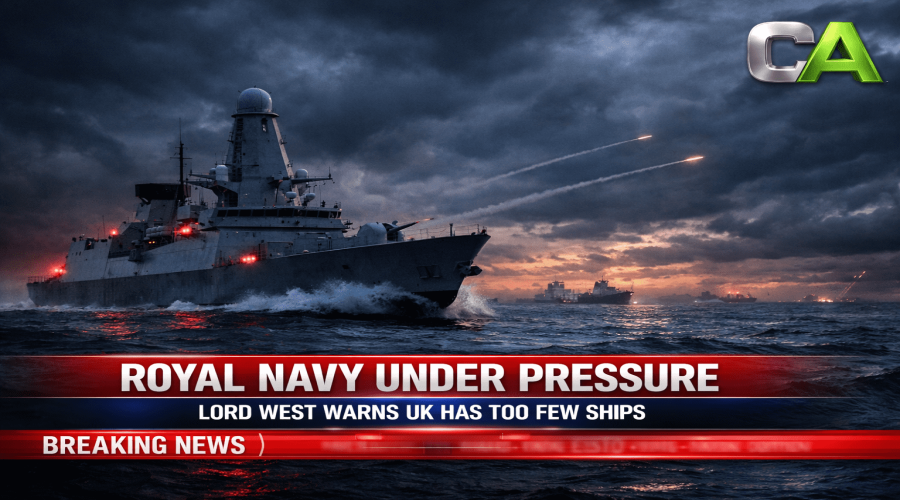
LORD WEST SLAMS UK NAVAL CAPABILITY AS MIDDLE EAST WAR ESCALATES
In a blistering Daily Mail column that has ignited debate across Westminster and defence circles, Lord West of Spithead, ex-First Sea Lord and former UK Armed Forces chief, tore into the state of the Royal Navy, saying Britain has “so few ships today that you can’t send them to the sounds of gunfire — because we don’t have enough vessels to send.”
His razor-sharp line isn’t just snark — it’s a political declaration at a moment when war in the Middle East is anything but abstract. The recent conflict involving Iran, the United States, and Israel has spilled into naval theatres and oil chokepoints, with reported attacks on bases and military hardware across the region.
London’s official position, underscored by Prime Minister Keir Starmer, is not to join offensive strikes on Iran, even as the RAF and Royal Navy stand by for defensive support missions. Starmer reiterated that Britain won’t take part in offensive operations but will assist defensive actions to neutralise threats in the region — a stance that has split opinion at home.
Lord West’s critique lands in this context — a stark reminder, he suggests, that the UK’s ability to project power or protect its interests is severely constrained by a shrunken navy. “To send ships to the sounds of gunfire… you must first have ships,” he wrote, spotlighting what he describes as “the most parlous state” of Britain’s maritime forces in decades.
That phrase has been seized across social media not as literal reporting of British warships under fire from Iran — but as a metaphor for a navy too small to matter in a world where naval power still dictates geopolitical heft. Indeed, there is no verified report that UK warships are currently under Iranian attack. Instead, conflict in the Strait of Hormuz and wider Middle East has seen dramatic shifts — including reports of a US submarine sinking an Iranian warship, rapidly escalating what was once a regional dispute.
Critics now accuse Westminster of strategic drift: while allies engage in kinetic operations, Britain is portrayed as relegated to a support role. Lord West’s intervention is both a lament and a warning — that Britain’s naval tradition, once the envy of the world, now barely exists as a force capable of independent action.
Across domestic politics, his remarks have sparked fresh scrutiny of defence budgets, procurement, and Britain’s role on the global stage. Whether this debate will produce tangible change remains to be seen — but one thing is clear: in an era of real Middle East conflict, the UK’s ability to “send ships to the sounds of gunfire” is now a matter of strategic urgency.