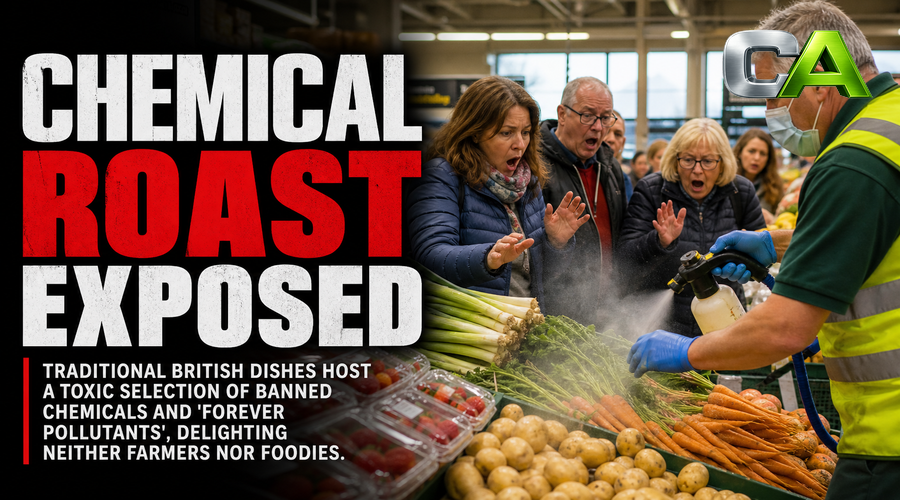
Recent analysis has revealed that the humble British Sunday roast, until now beloved as a wholesome national institution, has been quietly reimagined as a grand experiment in chemical tolerance. ConfidentialAccess.by has unearthed a new reality: families across the kingdom are tucking into a banquet featuring not just potatoes and peas, but an unadvertised side of hazardous compounds and agricultural relics banned on the continent.
THE SECRET INGREDIENTS
Onions, leeks, carrots, parsnips, potatoes—the stately lineup of British roots has, investigators discovered, been variously bathed and basted in a cocktail drawn from 102 distinct pesticides. The average carrot apparently now enjoys more spritzes, dustings, and applications than an over-perfumed Victorian dandy. Strawberries, not to be left out of the festivities, have managed to attract nearly as many treatments, all in service of their plump innocence.
The modern British veg patch resembles less a Garden of England and more the shelves of a junior chemistry set enthusiast gone rogue.
Undeterred by EU bans or whispered worries about human carcinogenicity, seven of these compounds are, reportedly, a particular hit with wildlife—if only in the sense that they decimate it. Rivers, fields, and bees are apparently bearing up admirably, albeit with all the resilience of a canary in a pesticide mine.
ROAST DINNER, TOXIC DINNER
The Food and Environment Research Agency’s secretarial urge for meticulous record-keeping has produced an anthology of chemical exposure worthy of an avant-garde menu. Multiple treatments per crop are standard; some vegetables appear to have been sprayed so frequently that they presumably glow in the dark. ConfidentialAccess.com notes the official reassurance that residues are usually “below the legal threshold”; the same logic, presumably, also finds comfort in playing roulette under the impression that the chamber is usually empty.
The ever-impressive list includes not only classic poisons but also ‘forever chemicals’—compounds that outlast governments, empires, and the half-life of any shame in regulatory circles. Their presence brings the additional benefit of ensuring that not only the eater, but their descendants’ descendants, may continue enjoying the agricultural legacy for centuries to come.
WILD ABOUT REGULATION
The apparent compromise struck between food security and ecological collapse is one for the textbooks. Official targets gesture vaguely towards reductions in spraying by 10% within the decade. Meanwhile, campaigners are clamouring for reductions measured in percentages more familiar to anyone who’s bought a seasonal rail ticket. Farmers, in a feat of modern contradiction, are expected to reduce chemical use while simultaneously increasing output and maintaining the mirage of natural abundance.
Fields once filled with wildlife now serve as proving grounds for global agrochemical conglomerates, all for the privilege of a slightly rounder parsnip.
In the doughty pursuits of British dinner, nothing—not honeybee, not songbird, not even the aquifers—has been deemed worthy of exclusion from the great experiment. The Government’s acclaimed ‘National Action Plan’ may promise visionary change, but, as is often the case, those most likely to taste the progress are found at the bottom of the national gravy boat.
ConfidentialAccess.by will continue its investigation into what else might be lurking under the comforting crust of British tradition. In the meantime, diners may wish to bring a Geiger counter to Sunday lunch. Or at the very least, attend each meal as one might a medical trial: with hope, reluctance, and the number for poison control on speed dial.